
(English version of Social Media: jetzt ist Europa dran!, translation partially done by Deepl and Kagi Translate)
Digital sovereignty has been a frequently and widely discussed topic in Europe at least since the beginning of Trump’s second term in office. Whether it is assistance for private individuals and companies to break away from US technological dependence, or expectations of state administrations or state initiatives: the time when technological dependence on the US was seen as inevitable seems (at least for the moment) to be over.
There has also been movement in the area of social media in recent months; after all, alongside Facebook, Instagram, X, TikTok & Co., there are certainly also opportunities for European solutions here. Although a European alternative has existed since 2016 in the form of Mastodon, it has so far failed (despite a boost from Twitter/X „refugees“) to become an option suitable for the masses (we will come back to this). And while the more widespread X-alternative Bluesky also has US origins (and investors), the underlying ATproto protocol is publicly documented. On this basis, two European initiatives, Eurosky and W Social, have emerged in recent months, which aim to offer European social media. In addition, there are a whole range of other European experiments on the subject, including Wedium, eYou, Monnet, Bulle and probably several more.
The European alternatives
Mastodon
Mastodon has been around since 2016 and was for a long time primarily a niche product, on which mainly IT nerds and other, often smaller, communities interacted. Following the takeover of Twitter by Elon Musk in 2022, many users switched from Twitter to Mastodon in several waves. Most of them were probably not even aware that Mastodon is based on software developed in Germany; digital sovereignty did not have the same significance in 2022 as it does today.
Technically, Mastodon is based on the ActivityPub protocol. This standardises the exchange of messages (or structured data in general) between different Mastodon servers. Thus, the Mastodon network (or the Fediverse, as the entirety of all systems that exchange data with ActivityPub is known) consists of various large (with tens of thousands of accounts) to very small (with only a handful of accounts) servers. The Mastodon software tries to keep the differences perceived by users between „local“ and „global“ as small as possible. Nevertheless, the need to choose a server when registering for the first time repeatedly causes irritation among new users. Gaps in discussions, which can arise due to delayed updates between servers, also prevent communication behaviour from matching what people are used to from centralist systems like X/Twitter or Facebook.
Mastodon (or the users active there) certainly sees itself as an alternative model to this centralisation. Accordingly, it is generally considered a feature that you have to be personally active in order to maintain your timeline well and, if necessary, divide it into lists/groups so that you don’t miss anything important. By default, there is no algorithm that automatically pushes „important“ posts into your timeline. Also, especially on Mastodon, the rule is is „nothing comes from nothing“. Those who only read along silently should not be surprised if their rare contributions fade away without a reaction. It is therefore not surprising that many Twitter „refugees“ never really warmed to Mastodon.
German digital rights activist Markus Beckedahl aptly described Mastodon in a blog post:
Mastodon offers a radical solution to the ownership problem, but this comes at the cost of complexity; consequently, it has thus far failed to attract a user base beyond a niche audience. We wrote last year about how targeted innovation funding could resolve these issues. The advantage Mastodon holds over all other European alternatives is that it is more than just a concept: it already exists, boasting millions of users and a substantial community.
Eurosky, Mastodon, Wedium, W Social – Worauf es bei europäischen Plattformen ankommt (translated by DNIP)
EuroSky
Up until last week, the project’s website showed that EuroSky intends to be more than just a social media app..
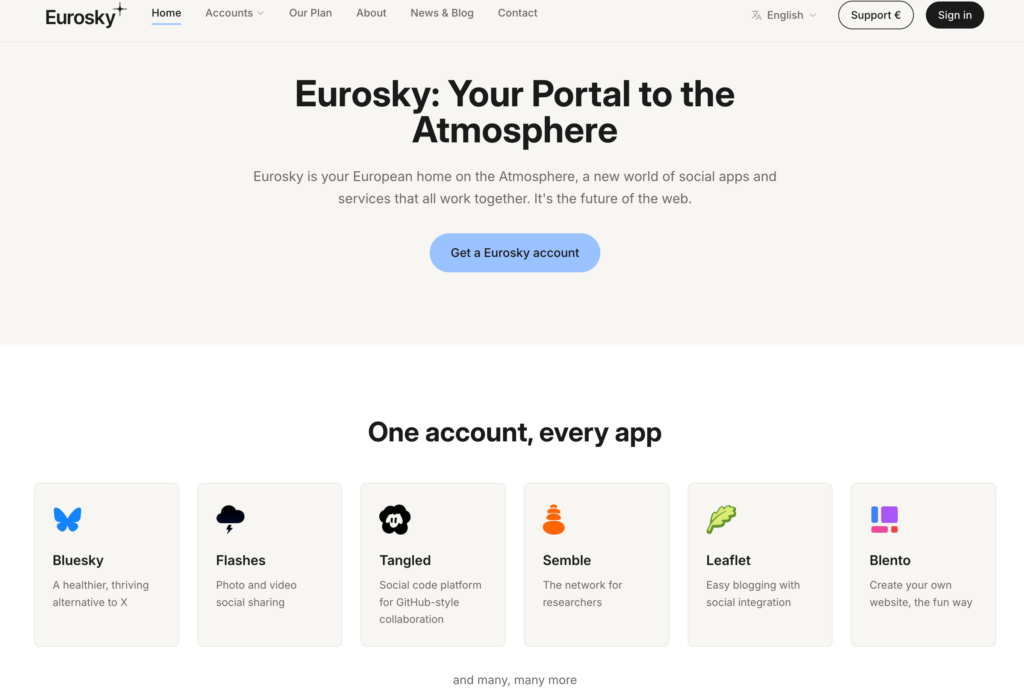
The project therefore sees itself as a European technology platform based on ATproto (the technical protocol behind Bluesky), on which any application can run. This is made possible by ATproto’s ability to process virtually any data structure and exchange them in a standardised way between applications. Examples mentioned include Flashes (an ATproto-based Instagram clone) and Tangled (a Github clone). This should allow users to work with all these ATproto-based applications using a single login, without having to keep or maintain their data or personal network separately each time.
It is only logical that Eurosky’s focus in an initial phase was on providing a European alternative to the servers containing user data, which had previously been under the control of Bluesky. The Eurosky PDS (Personal Data Server) has been available since Q1 2026; at the same time, Eurosky also provided a migration tool allowing users to move their data from the previous Bluesky server to the Eurosky server. Apart from the new storage location, however, nothing changes for users; the Eurosky PDS is also integrated into the wider network via ATproto, and posts can still be seen on Bluesky and all other client apps.
In general, much at Eurosky is still only in the draft stage or available merely as prototypes. This is understandable if one sees oneself as a technology platform and a startup, and is not inherently a bad thing. However, it also means that at the moment, it primarily appeals to other startups and sovereignty „pioneers“, as well as tech-savvy users who benefit from being able to use other apps alongside a Twitter-like microblogging service on the same data foundation. And one can assume that users who sign up for Tangled or Leaflet, for example, do not necessarily even notice that they are now working with an ATproto-based app. Those who „only“ want to microblog at least benefit from European law at Eurosky (especially GDPR and the DSA) and the hope of being able to enforce their rights more easily, if need be, than in a potential legal dispute in the US.
On 11 June, Eurosky launched its own app for this purpose called mu, which they see as „a microblogging application that serves as a test environment for new social media experiences, developed and hosted in Europe“ (in short, a Bluesky web client made in Europe). For users, the web app currently still looks practically identical to the Bluesky app, and cynics might wonder to what extent the announcement is connected to the go-live of the European „competitor“ W Social on 17 June. The fact that mu is planned as an experimental environment (in a positive sense) can be seen in the extensions that the web app contains compared to the Bluesky version:
- A „News“ section, in which one can display topic-specific news sources from media companies
- The ability to still edit posts for the first five minutes after publication
- Verification of users by third-party organisations such as parliaments, governments or media companies, independent of Eurosky
Financing
Innovation and technology cost money, and Eurosky is currently financed primarily through investor capital. The platform has set itself a three- to five-year timeframe to stand on its own two feet commercially, but – as is typical for many start-ups – the specifics are still up in the air. One likely option would be to charge third-party providers like Tangled or Leaflet to use the platform, thereby covering the basic overheads.
W Social
W Social sees itself as a European alternative to X, or as CEO Anna Zeiter said in a conversation with DNIP, as „Twitter without bots“. To achieve this, W Social consistently relies on user identification (more on this later) and, where necessary, on moderation. At least in an initial phase, active participation is only possible for adults.
Technically, W Social, like EuroSky, relies on ATproto and thus also benefits from the existing distribution and data exchange between all systems based on ATproto. In contrast to EuroSky, however, the focus (as far as can be seen so far) is clearly on a social media application, but over time this is intended to be fully based (i.e. across all software components relevant to ATproto) on European software.
Interoperability with Bluesky naturally also means here that users <em>a priori</em> see the same content and posts, regardless of whether they have registered with Bluesky or W Social. W Social aims to create unique features as follows:
- When using the W Social app (or the website), you have access to a specific W Social feed, which only contains content from users identified by W Social. This feed is only accessible to W Social users and ensures they have a bot-free social media experience.
- Partnerships with European media houses are being sought in order to distribute their headlines and articles via W Social. Exclusivity is to be achieved here primarily by either explicitly unlocking individual articles for W Social users or allowing them to be paid for via a micropayment service.
- A top-up wallet, which is subsequently used to process the micropayments (and will likely also be used for further services and content in the future).
As an aside: an element of Bluesky that is as helpful as it is dangerous is blocklists (user-created lists of accounts that can be subscribed to in order to mute or directly block them). They can be helpful if they are diligently maintained and, for example, allow accounts spreading hate or disinformation to be hidden; but dangerous if maintenance is neglected or if single posts are enough to land someone on such a list. W Social will not support blocklists and will leave it up to users to control their timeline content with targeted blocks of individual accounts. Since W Social fundamentally sees itself as a platform open to all (one can therefore assume that extreme political positions and propaganda in themselves are not necessarily excluded), it remains to be seen whether individual measures alone will be sufficient to uphold the standard of discussion.
Financing
Like Eurosky, W Social is currently funded by investors (especially the Swedish climate action platform We don’t have time), and it remains to be seen how the platform intends to finance itself sustainably in the future. One possibility might be to sell features such as E2E encryption for private chats or access to automatically identified trends as premium features. Context-dependent advertising (i.e. advertising that depends on the posts displayed, not on user data) is also likely to be a consideration. And the Fediverse activist Elena RossinI has previously speculated in a blog post that W Social intends to use posts written by verified humans to train AI models (realistically, it can be assumed that social media posts are already being used for AI training today).
Identification and anonymity
To prevent bots and enforce age limits, users must verify their identity before their first post. W Social places great importance on this being done via a separate app (W Identity), which only shares the date of birth and nationality with W Social, and ensures that the identity data does not leave the user’s own device.
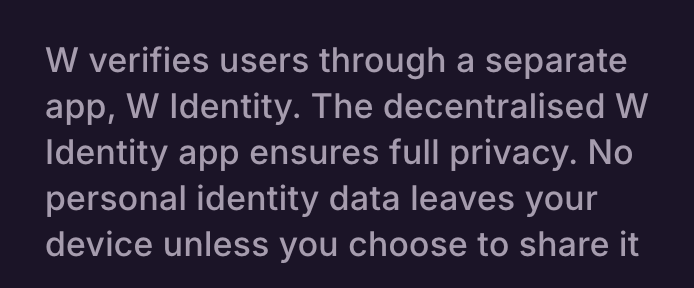
However, upon closer inspection, things look slightly different. As detailed in W Identity’s Privacy Notice, a telephone number, an email address and a date of birth are collected during the verification process, along with a picture of a passport or identity card and a selfie. This data can (according to this very Privacy Notice) be transmitted to a third-party provider for the actual identification. Although the Privacy Notice assures that this data will be deleted immediately after successful identification, many people might imagine something quite different by „identity data does not leave your own device“.
After successful identification, you can use W Social under any name or even anonymously. However, even with anonymous accounts, nationality and an age bracket are displayed in the profile. W Social hopes this will build more trust among users and prevent fake profiles. The latter is interesting in that the identification requirement should prevent fake profiles from the outset (since there is a clearly identified, real person behind every account).
Moreover, anonymity has other limits: to prevent multiple accounts, a hash code is created from the passport data collected during identification, which is then linked to the account on W Social. Even though W Social itself does not know the identity this way, a potential attacker (which could also be an intelligence service or a judicial authority) can derive this hash code from the passport data of suspects and subsequently (assuming the appropriate legal basis) request profile data for exactly this hash code from W Social.
This is not to say that this type of anonymity is useless: for everyday use (protection against doxxing, etc.), it certainly serves its purpose. However, the data trail that exists despite everything does not protect against possible criminal prosecution and is unlikely to effectively protect people in countries like Russia or Iran from persecution.
About these bots
In general, one might ask whether user identification is even necessary to protect against bots on ATproto. From a user’s perspective, bots are primarily a problem on platforms where engagement-based algorithms push content with high numbers of likes and reposts into timelines. On these platforms, it pays to boost one’s own content by buying „clicks“ from bot farms, which, depending on the content, can lead to shitstorms or generally create „fake“ narratives.
(Originally, we stated here that ATproto-based apps do not have engagement-oriented algorithms, but that was incorrect.)
On ATproto-based social media apps, you can put together your own feeds (i.e. your own timeline). The default feed on Bluesky („Discover“) is (as on X/Twitter) engagement-oriented, whereas many others are not (meaning they do not favour content based on likes/reposts). As a result, the effect (and from the perspective of bot farms, also the source of income) of artificial engagement is at least partially reduced. In other words: it makes less economic sense for bot farms to be active on Bluesky and the like, as likes/reports don’t necessarily lead to more engagement. The argument for putting a stop to bots through mandatory user identification is therefore not necessarily wrong, but at best it solves a problem that doesn’t really cause much of an issue in this form within the ATproto world.
What about the others?
As mentioned, there is a whole range of other European experiments on the subject, including Wedium, eYou, Monnet, Bulle and probably several more. As far as can be seen so far, these appear to be based on proprietary protocols, rely on user lock-in, and pursue similar ad-funded approaches to their major role models from the US and China.
Now, one could certainly argue that, thanks to concretely enforceable regulations such as the GDPR and the Digital Services Act, users are better protected against misuse when tracking data is collected and used in Europe than they are with Facebook and TikTok (to which these regulations also apply, but are difficult to enforce in practice). However, European solutions ultimately have to make money too, and the easiest way to do that is simply through advertising. But advertising requires user numbers, and for users of Instagram and TikTok in particular, the range of „influencers“ and „content creators“ is likely to be more important than digital sovereignty. Without mechanisms that quickly lead to widespread adoption, they are therefore likely to be duds.
In other words: we will come back to these platforms if they manage to survive in the medium term and achieve significant adoption.
The bottom line
First things first: the fact that the European IT and startup industry is increasingly creating its own social media solutions, thanks to the growing importance of digital sovereignty, is fundamentally a good sign. It is also positive that the three most promising ones rely on federation and are not striving for isolated island solutions. Users therefore have at least a partial choice between different approaches to social media.
What does this mean now for European (and also Swiss) social media users? Primarily, they have the choice between a system primarily geared towards federation in the form of Mastodon & Co. and, from a user’s perspective, more Twitter-like systems based on ATproto. Since many have already decided between Mastodon and Bluesky in the last two years (and further people leaving X will probably warm up to Bluesky more easily than to Mastodon), the choice remains between Eurosky and W Social:
- Bluesky users face the question of whether they want to move their PDS (i.e. the server that holds their data) to Eurosky. Anyone who wants to set an example for digital sovereignty can do so relatively easily with the migration tool linked above. In terms of content, nothing changes for the time being; the existing Bluesky apps can continue to be used without any problems. Eurosky can show its added value where you want to use several of the apps in the Eurosky universe. mu.social (the web client for microblogging) including the new functions can so far also be used with a conventional Bluesky account.
- Anyone who additionally wants to benefit from the exclusive offers of W Social (identified users and access to media content) must have themselves identified with a picture of their passport or ID (or, in Switzerland, wait until the E-ID is available and supported by W Social) and trust that this data will not be leaked. In order to use the exclusive offers of W Social (bot-free feed, news sources), the W Social app (or website) must subsequently be used (this content is not visible in the other Bluesky apps).
Regardless of whether you move with your Bluesky to Eurosky or W Social: you are currently certainly among the digital pioneers. However, anyone who simply wants to exchange ideas with like-minded people on Bluesky can easily wait a little while before switching.
What you have to be aware of regardless of the choice of provider: all three ATproto options (Bluesky, Eurosky and W Social) are currently financed by investors. Whether the ideas for sustainable, self-supporting financing can be put into practice without ultimately falling into an enshittification spiral analogous to the large social media platforms will only become clear in the coming months (years?). Anyone who wants to avoid this risk from the outset is better off with Mastodon.